
 Kia Optima: Recommended SAE viscosity
number
Kia Optima: Recommended SAE viscosity
number
 CAUTION
Always be sure to clean the area around any filler plug, drain plug, or dipstick before checking or draining any lubricant. This is especially important in dusty or sandy areas and when the vehicle is used on unpaved roads. Cleaning the plug and dipstick areas will prevent dirt and grit from entering the engine and other mechanisms that could be damaged.
Engine oil viscosity (thickness) has an effect on fuel economy and cold weather operating (engine start and engine oil flowability). Lower viscosity engine oils can provide better fuel economy and cold weather performance, however, higher viscosity engine oils are required for satisfactory lubrication in hot weather. Using oils of any viscosity other than those recommended could result in engine damage.
When choosing an oil, consider the range of temperature your vehicle will be operated in before the next oil change. Proceed to select the recommended oil viscosity from the chart.
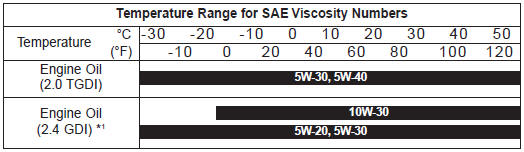
*1. For better fuel economy, it is recommended to use the engine oil of a viscosity grade SAE 5W-20 (API SM / ILSAC GF-4). However, if the engine oil is not available in your country, select the proper engine oil using the engine oil viscosity chart.
 Recommended lubricants and capacities
To help achieve proper engine and powertrain performance and durability, use
only lubricants of the proper quality. The correct
lubricants also help promote engine efficiency that results in impro ...
 Vehicle identification number (VIN)
The vehicle identification number (VIN) is
the number used in registering your vehicle
and in all legal matters pertaining to
its ownership, etc.
VIN label
The VIN is also on a plate a ...
See also:
Windshield wipers
Operates as follows when the ignition switch is turned ON.
MIST : For a single wiping cycle, push the lever upward and release it with the
lever in the OFF position. The wipers will operate conti ...
Vehicle option
1. When the vehicle is at a standstill, pressing the TRIP button for more than
2 seconds with the ENGINE START/STOP button in the ON position or engine running,
the LCD display on the cluster wi ...
Removal
1.
Disconnect the battery negative
cable and wait for at least three minutes before beginning work.
2.
Remove the glove box housing.
(Refer to the Body group- crash p ...
Categories
Kia Optima Manuals
- Kia Optima DL3 2019-2026 Owners Manual
- Kia Optima DL3 2019-2026 Service and Repair Manual
- Kia Optima TF 2011-{2019} Owners Manual
- Kia Optima TF 2011-2026 Service Manual
- Kia Optima MS/Magentis 2000-2005 Owners Manual
