 Kia Optima: Repair procedures
Refrigerant System Service Basics
Refrigerant Recovery
Use only service equipment that is U.L-listed and is certified to meet the requirements
of SAE J2210 to remove HFC-134a(R-134a) from the air conditioning system.
| - |
Air conditioning refrigerant
or lubricant vapor can irritate your eyes, nose, or throat. |
| - |
Be careful when connecting
service equipment. |
| - |
Do not breathe refrigerant
or vapor. |
|
If accidental system discharge occurs, ventilate work area before resume of service.
Additional health and safety information may be obtained from the refrigerant and
lubricant manufacturers.
| 1. |
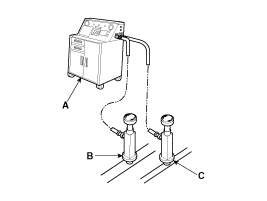
Connect an R-134a refrigerant
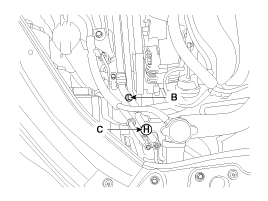
Recovery/Recycling/Charging System (A) to the high-pressure service port
(B) and the low-pressure service port (C) as shown, following the equipment
manufacturer's instructions.
|
| 2. |
Measure the amount of refrigerant
oil removed from the A/C system after the recovery process is completed.
Be sure to install the same amount of new refrigerant oil back into the
A/C system before charging. |
System Evacuation
Use only service equipment that is U.L-listed and is certified
to meet the requirements of SAE J2210 to remove HFC-134a(R-134a) from the air conditioning
system.
| - |
Air conditioning refrigerant
or lubricant vapor can irritate your eyes, nose, or throat. |
| - |
Be careful when connecting
service equipment. |
| - |
Do not breathe refrigerant
or vapor. |
|
If accidental system discharge occurs, ventilate work area before resume of service.
Additional health and safety information may be obtained from the refrigerant and
lubricant manufacturers.
| 1. |
When an A/C System has been opened
to the atmosphere, such as during installation or repair, it must be evacuated
using an R-134a refrigerant Recovery/Recycling/Charging System. (If the
system has been open for several days, the receiver/dryer should be replaced,
and the system should be evacuated for several hours.) |
| 2. |
Connect an R-134a refrigerant
Recovery/Recycling/Charging System (A) to the high-pressure service port
(B) and the low-pressure service port (C) as shown, following the equipment
manufacturer's instructions.
|
| 3. |
If the low-pressure does not
reach more than 93.3 kPa (700 mmHg, 27.6 in.Hg) in 10 minutes, there is
probably a leak in the system. Partially charge the system, and check for
leaks (see Leak Test.). |
| 4. |
Remove the low pressure valve
from the low-pressure service port. |
System Charging
Use only service equipment that is U.L-listed and is certified
to meet the requirements of SAE J2210 to remove HFC-134a(R-134a) from the air conditioning
system.
| - |
Air conditioning refrigerant
or lubricant vapor can irritate your eyes, nose, or throat. |
| - |
Be careful when connecting
service equipment. |
| - |
Do not breathe refrigerant
or vapor. |
|
If accidental system discharge occurs, ventilate work area before resume of service.
Additional health and safety information may be obtained from the refrigerant and
lubricant manufacturers.
| 1. |
Connect an R-134a refrigerant
Recovery/Recycling/Charging System (A) to the high-pressure service port
(B) as shown, following the equipment manufacturer's instructions.
|
| 2. |
Add the same amount of new refrigerant
oil to system that was removed during recovery. Use only specified refrigerant
oil. Charge the system with 19.4 ± 0.88 oz. (550 ± 25g) of R-134a refrigerant.
Do not overcharge the system the compressor will be damaged. |
Refrigerant Leak Test
Always conduct a leak test with an electronic leak detector
whenever leakage or refrigerant is suspected and when conducting service operations
which are accompanied by disassembly or loosening or connection fittings.
|
In order to use the leak detector properly, read the manual supplied by
the manufacturer. |
If a gas leak is detected, proceed as follows:
| 1. |
Check the torque on the connection
fittings and, if too loose, tighten to the proper torque. Check for gas
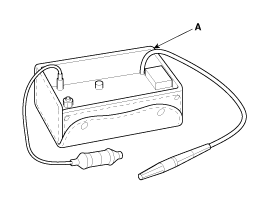
leakage with a leak detector (A). |
| 2. |
If leakage continues even after
the fitting has been tightened, discharge the refrigerant from the system,
disconnect the fittings, and check their seating faces for damage. Always
replace, even if the damage is slight. |
| 3. |
Check the compressor oil and
add oil if required. |
| 4. |
Charge the system and recheck
for gas leaks. If no leaks are found, evacuate and charge the system again.
|
See also:
Floor mat anchor(s)
When using a floor mat on the front floor carpet, make sure it attaches to the
floor mat anchor(s) in your vehicle. This keeps the floor mat from sliding forward.
WARNING
The following must be ...
Replacement
Front brake pads
1.
Loosen the guide rod bolt (B)
and pivot the caliper (A) up out of the way.
Tightening torque:21.6
~ 31.4 N.m (2.2 ~ 3.2 kgf.m, 15.9 ~ 23.1 lb-ft)
...
SS-A Solenoid Valve(ON/OFF). Specifications
Specifications
ON/OFF Solenoid Valve(SS-A, SS-B)▷ Control type : Normal low type
Control pressure kpa(kgf/cm², psi)
490.33(5.0, 71.12)
Internal ...



 Description and Operation
