 Kia Optima: Removal
| 1. |
Turn ignition switch OFF and
disconnect the negative (-) battery cable. |
| 2. |
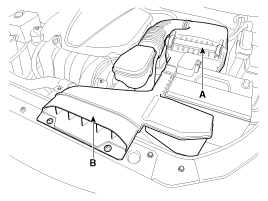
Remove the air duct (B) and air
cleaner assembly (A).
|
| 3. |
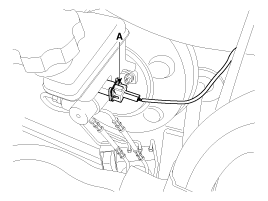
Disconnect the brake fluid level
switch connector (A), and remove the reservoir cap.
|
| 4. |
Remove the brake fluid from the
master cylinder reservoir with a syringe.
| •
|
Be sure to completely
remove foreign substances from around brake fluid reservoir
and cap before opening the reservoir cap. If not, it may
cause contamination of brake fluid and deterioration in
braking performance. |
| •
|
Do not spill
brake fluid on the vehicle, it may damage the paint; if
brake fluid does contact the paint, wash it off immediately
with water. |
|
|
| 5. |
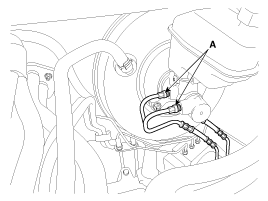
Disconnect the brake tube (A)
from the master cylinder by loosening the tube flare nut.
Tightening torque:18.6
~ 22.6 N.m (1.9 ~ 2.3 kgf.m, 13.7 ~ 16.6 lb-ft)
|
|
| 6. |
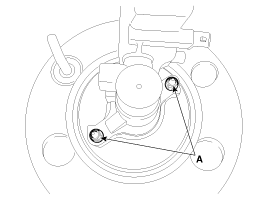
Remove the master cylinder from
the brake booster after loosening the mounting nuts (A).
Tightening torque:12.7
~ 16.7 N.m (1.3 ~ 1.7 kgf.m, 9.4 ~ 12.3 lb-ft)
|
|
1.
Installation is the reverse of
removal.
2.
After installation, bleed the
brake system. (Refer to Brake system bleeding)
...
See also:
Jump starting
Jump starting can be dangerous if done
incorrectly. Therefore, to avoid harm to
yourself or damage to your vehicle or
battery, follow these jump starting procedures.
If in doubt, we strongly r ...
Vehicle identification number (VIN)
The vehicle identification number (VIN) is
the number used in registering your vehicle
and in all legal matters pertaining to
its ownership, etc.
VIN label
The VIN is also on a plate a ...
Warnings and indicators
All warning lights are checked by turning the ignition switch ON (do not start
the engine). Any light that does not illuminate should be checked by an authorized
Kia dealer.
After starting the en ...



 Installation